Enterprise AI · Governance · Operational architecture
The Missing Layer in Enterprise AI
Enterprise AI will not be won by the company with the cleverest chatbot. It will be won by the company that can safely turn AI intent into governed action.
LLMs generate probable outputs. Enterprise systems require controlled, traceable, and authorised execution. The gap between those two worlds is the managed boundary — the governance and execution layer that converts AI-generated intent into safe, validated, and auditable business action.
Without that layer, organisations risk connecting probabilistic AI directly into deterministic infrastructure. With it, AI can propose, the boundary validates, the organisation controls, and the system executes — with policy checks, approvals, audit logging, and rollback where needed.
That is the real challenge now emerging inside organisations. The problem is no longer whether large language models can generate impressive responses, or whether AI agents can complete tasks in a controlled demo environment. The real challenge is whether enterprises can allow AI systems to participate in operational workflows without creating instability, compliance failures, security risks, or uncontrolled automation.
Most enterprise AI discussions are still happening at the wrong layer.
The conversation is dominated by prompts, copilots, autonomous agents, and model benchmarks. Every week brings another prediction that AI employees are about to replace entire departments. Yet once organisations move beyond experimentation and begin integrating AI into real systems, a different problem appears.
LLMs generate probable outputs. Enterprise systems require controlled, traceable, and authorised execution.
That mismatch is where many enterprise AI initiatives begin to struggle.
The missing layer between those two worlds is what I call the managed boundary: the governance and execution layer that converts AI-generated intent into safe, validated, and auditable business action.
Over the next few years, this may become one of the most important architectural concepts in enterprise AI.
Why AI demos look easy — and production systems do not
Large language models are extraordinarily capable at interpreting language, summarising information, generating options, and proposing actions. That capability is why AI demonstrations often feel revolutionary.
But enterprises do not operate on possibility alone.
They operate through policies, permissions, audit trails, approval chains, regulatory obligations, operational accountability, and controlled execution. A chatbot answering customer questions is relatively straightforward. Allowing AI to update customer records, issue refunds, modify contracts, trigger payments, or influence healthcare workflows is an entirely different category of problem.
The issue is not whether the AI is intelligent.
The issue is whether the organisation can control what happens next.
This is why so many AI pilots look impressive while production deployments become difficult. The closer AI moves toward operational execution, the more governance suddenly matters.
A simple example
Imagine a customer messages a telecom provider:
“I’ve had service issues for three months. I want compensation and cancellation.â€
An advanced AI assistant may correctly infer frustration, churn risk, refund eligibility, and cancellation intent. Without a managed boundary, the AI could directly issue a refund, terminate the contract, update billing systems, and trigger downstream operational processes.
At first glance, that sounds efficient.
Until the refund exceeds policy limits, violates retention procedures, breaches a regulated workflow, or incorrectly cancels a business account linked to multiple services.
Now compare that with a governed system.
The AI still interprets intent and proposes an action, but the managed boundary sits between interpretation and execution. It checks customer status, validates policy eligibility, applies approval thresholds, logs recommendations, routes exceptions to humans where necessary, and preserves rollback capability before any operational action occurs.
The AI still provides intelligence.
But the organisation retains control.
That distinction is critical.
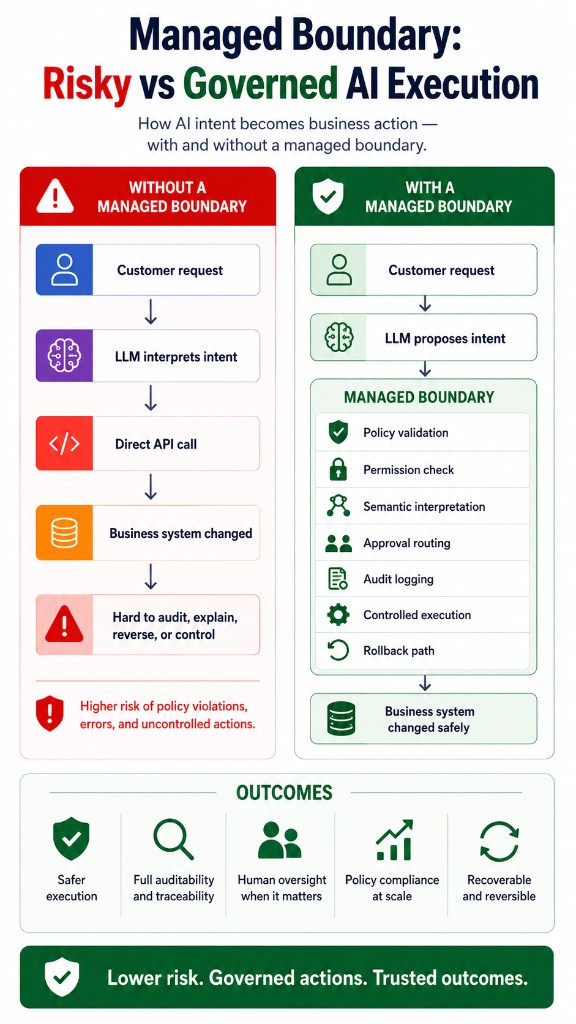
The difference in one picture
The infographic below contrasts risky direct execution with governed execution through a managed boundary.
Managed boundary: risky vs governed AI execution — without a boundary, LLM intent can drive direct API calls that are hard to audit or reverse; with a managed boundary, intent passes through policy, permissions, approvals, and controlled execution before systems change.
This is the difference between AI acting as a clever interface and AI becoming reliable enterprise infrastructure.
The dangerous myth of fully autonomous enterprise AI
Much of today’s AI narrative assumes the future belongs to fully autonomous agents operating with minimal oversight.
That may work in low-risk environments. It is far less likely to succeed inside heavily regulated, operationally complex enterprises.
Once AI systems begin interacting with finance platforms, healthcare workflows, contracts, infrastructure, customer records, or public services, autonomy without governance quickly becomes a liability rather than an advantage.
Boards and regulators will not ask whether the prompt was elegant. They will ask:
Who approved this action?
Can the decision be audited?
What happens if the AI is wrong?
Can the workflow be reversed?
How are permissions enforced?
How do we prevent uncontrolled agent behaviour?
These are not prompt-engineering questions. They are operational architecture questions.
And importantly, they are not entirely new problems. Enterprises already understand governance through disciplines such as DevOps, MLOps, identity management, workflow orchestration, API governance, policy enforcement, and audit control.
The managed boundary does not replace those disciplines. It brings them together around AI-driven execution.
The managed boundary as an enterprise control layer
The managed boundary is not a single product or technology stack. It is an architectural layer sitting between probabilistic AI systems and deterministic operational systems.
On one side sit LLMs, AI agents, semantic interpretation systems, reasoning engines, and generative interfaces.
On the other side sit databases, CRMs, finance systems, healthcare platforms, APIs, operational infrastructure, and regulated workflows.
The boundary governs how AI-generated intent becomes real-world execution.
In practice, this may involve policy engines, orchestration frameworks, semantic models, approval systems, runtime governance layers, audit frameworks, and human-in-the-loop controls. The specific technologies matter less than the architectural principle itself:
AI should not move directly from interpretation to execution without governance in between.
Without that controlled layer, organisations risk connecting probabilistic systems directly into deterministic infrastructure. That may work for demonstrations. At enterprise scale, it becomes dangerous.
Managed boundary flow — from customer request and LLM-proposed intent through policy, permissions, semantics, approvals, audit, controlled execution, and rollback before systems change.
Why the semantic layer matters
One of the most underestimated problems in enterprise AI is semantic inconsistency.
Most organisations do not have a single, clean operational understanding of how work actually happens. Different departments use different meanings, undocumented exceptions exist everywhere, approval rules evolve informally over time, and customer language is interpreted differently depending on context.
Humans compensate for this ambiguity naturally. AI systems do not.
This is why many AI deployments appear intelligent during testing but behave inconsistently once exposed to real operational complexity.
The semantic layer is where the organisation teaches AI what its words, risks, workflows, policies, and exceptions actually mean.
That semantic structure may include internal ontologies, workflow taxonomies, decision schemas, policy definitions, event models, customer-intent mappings, and operational context frameworks.
At first glance, this can sound abstract. But the problem becomes very concrete once systems begin making decisions.
A “priority customer†may mean one thing to sales, another to finance, and something entirely different to customer support. “Urgent†may trigger immediate escalation in one workflow and next-day review in another. “Eligible for refund†may depend on contract type, customer tier, prior exceptions, jurisdiction, approval authority, and product history.
If those meanings are not clearly defined, AI does not automate the business. It automates confusion.
A second example: sales AI without governance
Consider a sales AI assistant reviewing a conversation with a prospective client.
The system detects strong buying intent, identifies urgency, and recommends a discount to close the deal. Without a managed boundary, the AI might update the CRM, apply the discount, generate a contract, notify finance, and mark the opportunity as committed revenue.
Individually, each step may appear reasonable.
Collectively, they may violate margin policy, bypass approval authority, distort forecast reporting, or create contractual obligations the business never intended to approve automatically.
With a managed boundary, the AI can still provide enormous value. It can summarise the discussion, identify likely buying signals, recommend next steps, draft the discount request, check policy thresholds, and prepare supporting documentation.
But execution still occurs through governed workflow.
That is the key enterprise pattern:
AI proposes. The boundary validates. The organisation controls. The system executes.
How enterprise AI works when it matters — from intent to impact through a managed boundary: AI proposes, the boundary validates, the organisation controls, and the system executes with audit and rollback.
Why this is becoming urgent
The first wave of enterprise AI was experimentation.
The next phase is operationalisation.
That changes the nature of the problem completely.
When AI is used to summarise meetings or support internal research, the operational risk is relatively low. But once AI begins influencing money movement, healthcare decisions, insurance workflows, infrastructure operations, legal processes, hiring decisions, or customer lifecycle management, trust becomes the central issue.
And trust is not created through better prompts alone.
Trust is created through governance, validation, explainability, permissions, monitoring, auditability, and recovery capability.
This is where enterprise AI investment will increasingly move over the next several years — not just toward larger models, but toward the operational control layers that make those models trustworthy enough to use in real business environments.
How organisations can start building a managed boundary
Most enterprises do not need fully autonomous AI systems immediately.
What they need first is controlled augmentation.
A practical starting point is to identify where AI-generated recommendations could become operational business actions. Those points represent the highest-risk transition areas between interpretation and execution.
For each workflow, organisations should ask:
What is the AI allowed to infer?
What is it allowed to recommend?
What is it allowed to execute?
What requires human approval?
What must be logged?
What can be reversed?
Which systems can be touched?
Which policies apply?
That separation between AI intent and operational execution is the beginning of the managed boundary.
From there, organisations can introduce policy validation, semantic definitions, audit logging, approval thresholds, permission models, workflow orchestration, and rollback capability.
The goal is not to slow AI adoption. The goal is to make AI operationally trustworthy.
The companies that win
The winners in enterprise AI may not be the organisations with the largest models.
They may be the organisations that build the safest, clearest, and most reliable bridge between AI reasoning and operational execution.
That bridge will look different in every industry.
In banking, it may focus on transaction controls, approvals, and compliance. In healthcare, it may focus on clinician review, patient safety, and auditability. In manufacturing, it may focus on operational resilience and exception handling. In government, it may focus on accountability, transparency, and controlled decision support.
But the underlying principle remains the same.
AI cannot become trusted operational infrastructure unless it operates inside governed systems.
Final thought
The next phase of enterprise AI will not be defined by autonomy without control.
It will be defined by intelligence operating inside governed systems.
The organisations that succeed over the next decade will not simply deploy more AI. They will build the architecture that allows AI to act safely, visibly, reversibly, and accountably inside real operational environments.
That architecture starts with the managed boundary.
And for enterprise AI, it may become the layer that separates impressive demonstrations from trusted production systems.
Where to start
If you are moving from AI experimentation toward operational use, start by mapping where intent becomes execution — and where a managed boundary is missing today.