Insight series · Executive AI insight
What organisations are struggling with now — and what comes next — when probabilistic AI meets deterministic business operations.
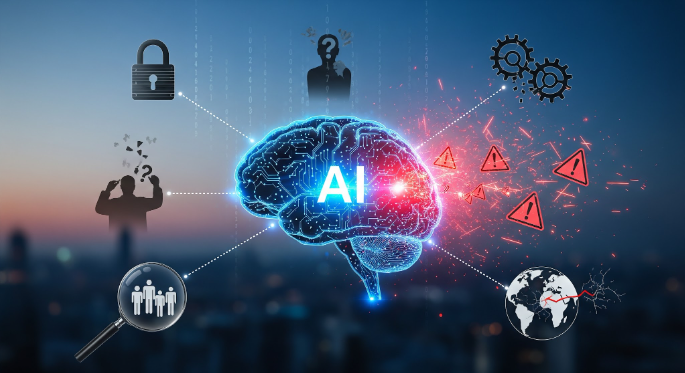
Most enterprise AI risk is not about hallucinations alone. It sits in the mismatch between probabilistic AI and deterministic business processes — plus weak validation, workflow misalignment, poor data context, security exposure, and the shift toward action-taking agents.
Organisations that succeed will treat AI as operational capability: governance before scale, workflows before automation, data before reliance on outputs, controlled execution before deploying agents, and human accountability even as machines become more capable.
Most conversations about AI risk are still happening at the wrong level. They tend to circle around hallucinations, prompt engineering, model benchmarks, deepfakes and whether AI will replace jobs. Those issues matter, but they are not where most enterprise AI programmes are actually succeeding or failing.
The real problem is more practical. Organisations are trying to introduce probabilistic AI systems into business environments that were built around deterministic processes. A payroll system is expected to calculate correctly. A banking transaction is expected to settle or fail in a controlled way. A compliance workflow is expected to follow policy, leave evidence and escalate exceptions. Large language models do not behave like that. They generate responses based on probability, context and interpretation, which means they can be useful, persuasive and wrong at the same time.
That mismatch is where much of the current AI risk now sits. The model may be impressive, but the surrounding organisation often has no clear operating model for how AI should be used, reviewed, controlled or integrated into real work. In many businesses, employees are already using AI every day while governance, security, workflow design and accountability are still catching up. Confidential material is pasted into external tools, AI-generated summaries enter decision processes, customer-facing content is produced with limited review, and internal copilots are connected to data sources before anyone has fully considered permissions, auditability or failure modes.
At small scale, this can look harmless. At enterprise scale, it becomes a serious operational risk.
One of the biggest current problems is not simply that AI can hallucinate. The larger issue is that AI can sound confident enough to make people stop checking. A junior analyst may use AI to summarise a contract and miss a critical obligation. A finance team may accept a polished AI-generated report that contains subtle numerical or contextual errors. A healthcare administrator may rely on an AI-generated interpretation of a document without sufficient review. In each case, the risk is not just the incorrect output. It is the combination of speed, authority, automation and misplaced trust.
This is why validation is becoming one of the central disciplines of enterprise AI. Organisations do not only need better prompts; they need clear rules for when AI output can be used, when it must be reviewed, who is accountable for the result, and how errors are detected before they reach customers, regulators or operational systems. Without that layer of control, AI does not remove risk. It accelerates it.
A second major problem is workflow misalignment. Many AI pilots look impressive in a demonstration but fail when introduced into the messy reality of day-to-day operations. The assistant may generate useful content, but not in the right format. It may answer questions, but not fit the approval process. It may save time for one team while creating extra checking work for another. In practice, employees may end up rewriting AI outputs, managers may lose confidence because they cannot see where the answer came from, and teams may bypass the tool because it interrupts rather than supports the way work actually gets done.
This is one of the reasons so many AI projects stall after the pilot phase. The issue is rarely that the model cannot produce something impressive. The issue is that the organisation has not redesigned the workflow around the new capability. AI has to sit inside real business processes, with real roles, real exceptions, real controls and real consequences. If it does not, it becomes another disconnected productivity tool rather than a scalable operational capability.
Data and context problems are another major source of failure. Many leaders assume AI problems are mostly model problems, but weak internal data will undermine even the best model. If company documentation is outdated, duplicated or contradictory, an AI assistant will reproduce that confusion in a more polished form. If different departments use the same terms to mean different things, AI can amplify semantic confusion across the business. If a retrieval system pulls from stale policies, old contracts or poorly tagged documents, the answer may sound authoritative while being operationally wrong.
In that sense, AI acts as a pressure test for the organisation. It exposes problems that were already there: poor documentation, fragmented knowledge, unclear ownership, inconsistent definitions and weak information governance. The difference is that AI makes these weaknesses visible faster and at greater scale. Organisations that want reliable AI often discover that they first need better knowledge management, better metadata, better process ownership and cleaner operational context.
Security and data exposure are also becoming more serious. The immediate risk is obvious: employees may paste confidential information, customer data, legal material or commercial strategy into tools that have not been approved for that use. But the risk is now moving beyond basic data leakage. Prompt injection, retrieval poisoning, API abuse, token theft, tool hijacking and unauthorised agent actions are becoming part of the AI security landscape. Once AI systems are connected to internal tools, databases, messaging platforms and workflows, the attack surface changes.
This becomes particularly important as AI shifts from advisory systems to action-taking systems. An AI assistant that drafts an email creates one level of risk. An AI agent that sends the email, updates the CRM, approves a refund, changes a customer record or triggers a workflow creates a much higher level of risk. At that point, AI is no longer just producing content. It is participating in business operations.
This is where the next wave of risk is forming.
Over the next few years, organisations will move increasingly toward autonomous and semi-autonomous agents. These systems will not only answer questions; they will invoke tools, coordinate tasks, make recommendations, trigger actions and interact with other systems. That creates a very different kind of operational challenge. An agent may complete ninety-nine tasks correctly and then make one serious mistake at machine speed. It may order the wrong inventory because it misunderstood a constraint, trigger thousands of incorrect customer messages because of a flawed interpretation, or escalate a cybersecurity response because it misread a false positive.
The problem is not only that AI can make mistakes. The problem is that AI can make mistakes quickly, consistently and across connected systems.
This is why enterprises will need a managed boundary between AI reasoning and business execution. AI should not be allowed to move directly from suggestion to action without appropriate checks. There needs to be a control layer that handles permissions, policy enforcement, approval routing, validation, monitoring, audit logging, exception handling and rollback. This boundary is what allows probabilistic AI to operate safely inside deterministic business environments.
Without that boundary, organisations risk building systems that are impressive but unsafe. With it, AI can become much more useful because its outputs are constrained, reviewed and connected to the right operational controls.
Future risks will also become more complex as companies move from individual AI assistants to networks of agents. A single chatbot can be tested and monitored relatively easily. A group of agents coordinating across finance, operations, customer service, procurement and IT is a different matter. Failures may no longer come from one bad answer, but from the interaction between systems: conflicting objectives, corrupted memory, repeated loops, duplicated actions, poor handover between agents or escalation chains that no human properly understands.
Context integrity may become one of the most important AI disciplines of the next decade. As AI systems rely more heavily on memory, retrieval layers, vector databases and long-running context, organisations will need to know whether the information feeding the AI is accurate, current, authorised and safe. A corrupted context layer can quietly distort every downstream decision while the system continues to appear coherent. That is a dangerous type of failure because it may not look like a failure at first.
Synthetic identity and trust collapse will add another layer of complexity. Organisations will increasingly face AI-generated emails, voices, documents, meeting participants, approvals and evidence. Fraud will not only involve stolen credentials; it will involve convincing synthetic activity that appears legitimate. Businesses will need stronger verification models because traditional assumptions about identity, communication and evidence will become less reliable.
There is also a longer-term human risk that does not get enough attention. If organisations over-automate analysis, drafting, research and decision support, they may gradually weaken the human expertise required to supervise those systems. Junior employees may stop developing the judgement that previous generations built through direct experience. Managers may become dependent on AI summaries without understanding the underlying material. Over time, businesses could lose some of the very capability they need to validate AI outputs properly.
The irony is that the greatest future risk may not be that AI becomes too intelligent. It may be that organisations become less capable while relying on it more heavily.
The companies that succeed with AI will not simply be those that move fastest or buy the most advanced tools. They will be the ones that treat AI as an operational capability rather than a novelty. That means building governance before scale, designing workflows before automation, improving data before relying on outputs, controlling execution before deploying agents, and keeping humans accountable even when machines become more capable.
The real enterprise AI question is no longer whether AI works. It does.
The harder question is whether organisations can make it work safely, reliably and sustainably inside the real world.
If your organisation is moving from AI experimentation to operational use, start with validation rules, workflow design and the points where AI intent becomes business action.
Talk to AURVANTIS Group